American Libraries Magazine Menu
  • Magazine
    • Current Issue
    • Issue Archive
    • Features
    • Trends
    • Columns
    • Newsmakers
    • Spotlights
    • By the Numbers
    • Bookend
    • People
    • Library Systems Report
    • Design Showcase
  • Trending
    • Artificial Intelligence
    • Equity, Diversity, and Inclusion
    • Intellectual Freedom
    • Sustainability
    • Advocacy
    • Inside ALA
    • Jobs
    • Library Systems Report
  • AL Direct
  • The Scoop blog
  • JobLIST
  • AL Live webinars
  • #ALA150

doerrstevensonbig

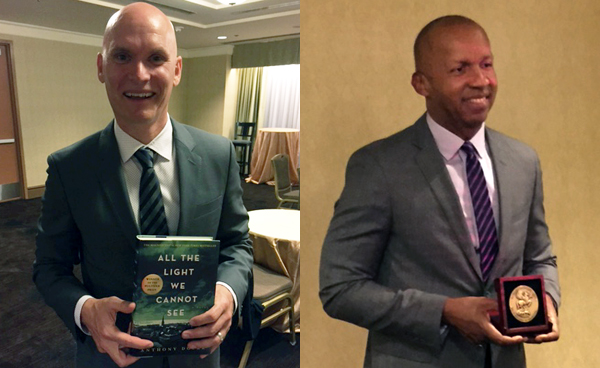
June 28, 2015 600 × 368 Doerr, Stevenson win 2015 Andrew Carnegie Medals
Anthony Doerr (left) with his book. Bryan Stevenson

Anthony Doerr (left) and Bryan Stevenson

Anthony Doerr (left). Bryan Stevenson shows his new medal.

Latest Library Links

  • 8h

    Library Legislative Day participants in the steps of the US Capitol circa 1994Gavin Baker writes: “Advocacy for libraries has been at the heart of ALA’s mission for 150 years. A new publication by ALA’s Public Policy and Advocacy Office explores milestones and other key achievements impacting school libraries, access to government information, copyright, civic engagement, library workers, the freedom to read, and more. These policies and initiatives enable the work of libraries thousands of times a day across the country.”

    ALA150, Sept. 30

  • 13h

    Montage of librariansElisabeth Egan and John Maher write: “We spoke with dozens of librarians at the ALA Annual Conference this summer in Chicago. They want you to know about book bans and budget cuts, but also about career counseling and crafting groups and pop-up medical clinics. They want you to worry, the way they worry, about artificial intelligence, looming legislation, and harassment of their staff. But most of all, they want you to know what the library really is: a safe place for people to gather around books, ideas, and one another. Here’s what librarians had to say, in their own words.”

    New York Times, Oct. 1

  • 16h

    ALA logoALA and the American Association of School Librarians endorsed the bicameral Quality Educator Partnership Act (QEPA). QEPA would address nationwide educator shortages by building federal infrastructure, removing barriers to the profession, expanding preparation pathways, and strengthening data and accountability. Notably, the bill also promotes efforts to make working in education a more attractive, affordable, and sustainable career options for today’s workforce. The bill’s provisions either directly specify the inclusion of school library media specialists or use the term “educator,” which, as defined, includes school library media specialists.

    ALA Public Policy and Advocacy Office, Sept. 30

  • 4d

    Canva logoEmily Long writes: “Canva is one of the most popular design tools for creating everything from fliers and business cards to interactive presentations. It’s pretty user-friendly even for those who don’t have any design experience, but if you want to level up your Canva experience, consider these tips and tricks.”

    Lifehacker, Sept. 29

  • 4d

    Documents from Mother Bethel African Methodist Episcopal Church held at City University of New York.Roger C. Schonfeld writes: “We are moving away from a model that is primarily organized around digital asset management. Instead, we may wish to think in terms of the activation infrastructure for distinctive collections. Rather than comparatively passive institutional digital custody, an activation infrastructure has as its purpose to maximize the impact of distinctive collections. This activation infrastructure incorporates library and archival professionals, technicians and student workers, distinctive collections, processing workflows, digital systems, and consortial and other cross-institutional tooling, among other elements. Foundationally, it is a kind of fly-wheel, benefiting from, and in turn generating, cross-institutional scale.”

    The Scholarly Kitchen, Sept. 29

  • 4d

    Map showing school boards included in the dashboardOlina Banerji writes: “School boards have been mired in fractious political debates in recent years. Fights with parents and community members have branched out to topics like transgender students’ rights and whether to remove certain books from school libraries. But beyond school board meetings, communities don’t have easy access to information on how their school board members vote on these topics. A new national dashboard will present data on how school boards in 161 districts vote on book bans, LGBTQ-student policies, limits on what teachers can teach, private school choice, and the presence of immigration enforcement agents in schools.”

    Education Week, Sept. 25

  • 5d

    Sleazy-looking telemarketerAbigail Goben writes: “About a year ago I was invited to give a lecture designed to spark critical thinking in graduate students when considering using generative artificial intelligence and other tools. I wanted something to hang the presentation on, and an acronym emerged. The ACToRS framework is a lens in which to consider the products and vaporware that is being marketed to us, to consider what problem we are trying to solve, and to take a step back from the exclamation points and assertions of Faster! Better! Now! It stands for: accountability, credit, trust, risk, and surveillance.”

    Hedgehog Librarian, Sept. 22

View more Latest Library Links

AL Live

al-live-logo@2x

AL Live screenshot with laptop


American Libraries Magazine

A publication of the American Library Association

  • Facebook
  • Twitter
  • BlueSky
  • RSS
  • Advertising
  • About
  • Comment Policy
  • Contact
  • Subscriptions
  • Submissions
  • Privacy Policy
  • Copyright/Terms of Use Statement
  • Site Help
American Library Association
  • ALA Home
  • JobLIST
  • ALA News
  • ALA Store
  • Strategic Directions

225 N. Michigan Ave., Suite 1300, Chicago, IL 60601

1.800.545.2433

© 2009–2026 American Library Association