
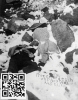
You receive a postcard in the mail from Colorado Springs. It says, “Wish you were here.” You look at it more carefully and notice the photograph is of a dead man. No, wait! A dead man—and a dead woman. The caption reads, “Frozen to death on Pikes Peak, August 21, 1911.” Really? Two people freezing to death in the middle of summer?
The macabre postcard depicting Willis and Sallie Skinner, prostrate among some rocks and covered by snow, is in fact an invitation to a film premiere from Pikes Peak (Colo.) Library District. The library produced the 30-minute Frozen to Death on Pikes Peak: A Cold Case Investigation in its Video Production Center and hosted the premiere on the 100th anniversary, August 21, 2011. The invitation also contained a QR code that, when scanned with a smartphone with the installed code-reader app, connected a user to a film trailer promoting the event.
PPLD librarians Kaitlin Hoke and Katie Rudolph engaged an audience of 280 who gathered in the community room of the district’s East Library to learn the truth behind the mysterious and seemingly preposterous tale. (It was indeed true; click here for the details). PPLD Executive Director Paula J. Miller welcomed the crowd and quickly surveyed how many in the audience received the postcard in the mail (80); how many people also own a smartphone (30); and how many of these smartphone owners scanned the QR code on the postcard to watch the film trailer (only one). Miller then used this information—the dearth of QR code aficionados in the audience—and turned it into a teachable moment, highlighting the practical uses for QR codes and noting that PPLD will be using them as a value-added information tool.
Although statistics indicated that only 2% of the nearly 2,000 postcard recipients scanned the QR code, PPLD’s Information Technology and Virtual Services Officer Carolyn Coulter didn’t consider the experiment a failure by any means. “It just shows we have to start educating our patrons on the benefits of this technology,” she said. “They are going to be seeing a lot more of this, in marketing and many other sectors of society. The public library is a great place to introduce them to QR technology.”
Aside from the “Frozen to Death” postcard campaign, PPLD’s Special Collections department has also been exploring other ways to apply QR codes. As part of its annual Pikes Peak Regional History symposia, PPLD has published a series of books that correspond to symposium topics. The books, part of the Pikes Peak Regional History Series, are available for checkout at PPLD or for purchase online and at local bookstores. QR codes are affixed to the packaging and link to short videos about the book’s content, allowing customers to evaluate before they buy.
PPLD partnered with the Colorado Springs Pioneers Museum on an exhibit in 2011 titled “Framing Community/Exposing Identity: Iconic Images Capturing Life at the Foot of Pikes Peak,” which also used QR codes. The exhibit displayed nearly 150 historic photographs from both collections and used hinged flaps to cover caption information, 30 of which included QR codes that linked to brief videos of exhibit curators who explained the significance of particular images. The hinged caption covers intended to encourage museum visitors to study each photograph before reading about them. “We want our exhibitions to inspire a sense of discovery,” said CSPM Director Matt Mayberry, “and these QR codes allow us to provide additional exhibit content using an interactive, exploratory format.”
PPLD’s district benefits greatly from its own Video Production Center, which provides commercial-quality films for the library district and operates a cable television channel of library content. Producer Jamey Hastings filmed and edited Frozen to Death on Pikes Peak over a period of seven months to ready it for the premiere. She also oversaw the creation of video content for every QR code link. The voice talents of PPLD staff, as well as the appearance of History Symposium presenters and local historians, contributed to the professionally finished productions.
“In an era when effective communication requires multimedia, our library district is fortunate to have a professional-quality video studio with public broadcasting capability—along with a cadre of talented staff who visualize, act in, and produce really cool productions for our community,” said Miller.
PPLD found Delivr to be an ideal code management platform, with simple code creation for URLs and text, as well as integrated tracking. Not only is Delivr a free service, it also provides exceptional options that many other companies would charge for. For example, the campaign can be tested, evaluated, and revised, and the URL can be substituted without changing the QR code itself. Delivr’s tracking information provides the number of scans, the type of device used, and when and where the scan occurred. The service also allows users to link up to 4,000 characters of text and offers options to embed links, images, and videos.
Many smartphone owners are still discovering the capabilities of their devices and have not yet explored the interactive world of QR codes. Similar coding technologies will someday be ubiquitous. But until then, the inexpensive and simple-to-use QR code can help libraries connect to tech-savvy users and bring local history to life.
TIM BLEVINS is manager of special collections for the Pikes Peak (Colo.) Library District.