It wasn’t her usual workplace attire, but Katherine Bunker was really looking forward to donning a pair of glittery green fairy wings.
Bunker, children’s librarian at Centennial Park Library (CPL) in Greeley, Colorado, had that opportunity as she prepared for one of her most popular summer programs last year. She also set out twigs, moss, leaves, pine cones, acorns, rocks, grass, berries, and other items gathered from her own home and around the library grounds.
Her workshop, part of the “Color Your World”–themed summer reading program, invited children to create fairy houses: tiny, whimsical structures made mostly out of natural materials. The event reached the program’s capacity of 20, with a waitlist.
“We were trying to think outside of paint and canvas” for a hands-on craft, says Mallory Pillard, CPL manager, describing how the event came to life. “The project opened discussion about fantasies, fairy tales, and recycling, and trickled into curiosity for new topics.”
Workshops where participants create fairy or gnome houses, offered at public libraries across the country, are gaining traction for their lighthearted appeal, suitability for all ages, and low-tech implementation, as supplies are cheap or free, often gathered from nature or recycled.
Funding for Bunker’s workshop came from the annual summer reading program budget. The only purchases she made were twine, additional dried grass and moss (about $20), and six-inch terracotta flowerpot saucers for the house foundations ($45 for 20 saucers). The library offers a summer lunch program that includes individual cartons of milk, so Bunker recycled them into house structures. Participants glued natural materials onto the cartons.
These workshop, while encouraging creativity, have tied into learning topics ranging from folklore and architecture to environmental awareness, all sprinkled with the fairy-dust joy of imagining where an enchanted creature might make a home.
“I was astounded by the architecture,” Bunker says. One child created a porch using one of the milk carton flaps. Another framed a balsa wood door with shells in a symmetrical pattern. “We need whimsy in our world right now,” she adds.
Building up to code
Lacey Alexis is assistant library technician at Juneau (Alaska) Public Library (JPL), which is surrounded by natural beauty, but much of it is wet and muddy, even in summer. Children at her first fairy workshop in 2023—inspired by the cardboard dollhouses she made with her sister as a child—were instructed to bring leaves, stones, and sticks, but she needed to find less soggy supplies.
Alexis hit thrift stores and found plastic foliage and flowers, beads, buttons, glitter, and other items, all for about $75. To make sure everyone had the same house frame, she cut up cardboard boxes into uniform shapes that could be formed into houses. She made 30 boxes, figuring on the average attendance for a program at her library. Dressed in gossamer white fairy wings and wearing a crown of flowers atop her long braids, Alexis nearly panicked on the day of the workshop when 130 people arrived. A tip she learned that day: Ask people to register, because these fairy workshops fill to capacity.
With only 30 house bases available, the kids had to form teams. “We ended up with a bunch of fairy apartments and condominiums,” Alexis says. “It turned into a lesson on shared housing.”
As word of the workshops has spread, community members have started donating materials, including cardstock and corks.
The program was originally envisioned for children, but when older patrons in 2025 asked for their own event, it expanded to two workshops: one for kids and another for adults. The two-day workshop attracted 136 kids and 67 adults.
Alexis was impressed with one adult who used the remains of a wreath from a craft store. Some other participants plucked the wreath’s foliage for their houses. The underlying wire circle was laying discarded, “but someone took it and made a beautiful fairy door, a portal into her fairy world.”
Nurturing nature
Emily Rucker, youth and outreach manager at Port Townsend (Wash.) Public Library (PTPL), also uses fairy house workshops to connect participants to the environment. She was inspired by a nearby library that had run a similar workshop with a local gardening author. “We liked that she talked about the importance of using natural materials,” Rucker says.
PTPL has offered fairy house workshops as part of its summer reading program since 2024 and is planning another for 2026. “It’s one of our most popular summer programs,” Rucker says.
For its first workshop, the library partnered with a local children’s book author to offer a combined author talk and interactive fairy house workshop for kids ages 4–12, which drew 100 participants. In 2026, Rucker plans to read Fairy Walk by Gaia Cornwall.
She uses the workshops to lead discussions on the importance of using organic materials and respecting nature and wildlife. “We talk about camouflage, how both animals and fairies stay hidden.”
To prepare for each workshop, Rucker collects shells, feathers, leaves, and flowers on nearby beaches or trails—“things that wouldn’t be disruptive to natural habitats” if removed, she says.
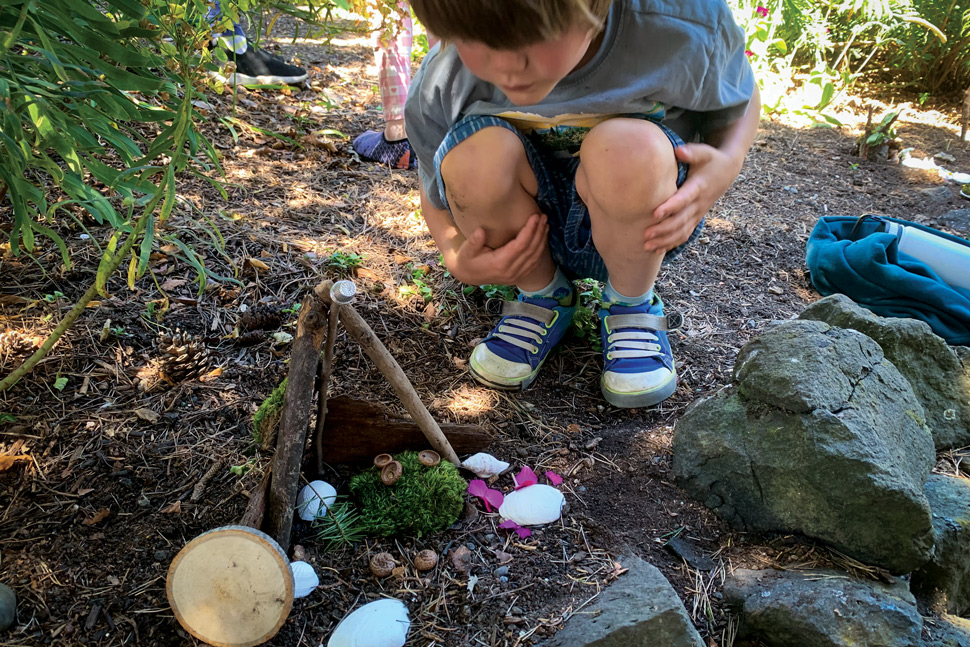
PTPL had kids build a little fairy neighborhood around the library, on trails, pathways, and in trees and gardens. Some of these houses were triangular, lean-to structures made of sticks; others resembled moss-covered stone hobbit homes. The library’s Friends group cleared the houses at the end of the summer. The only cost was an honorarium for the author at the first workshop.
“A lot of kids have been exposed to fairy tales or stories about fairies,” Rucker says. The fairy house project “gives them an opportunity to make it their own and gets them thinking about how to reuse material items for another purpose.”