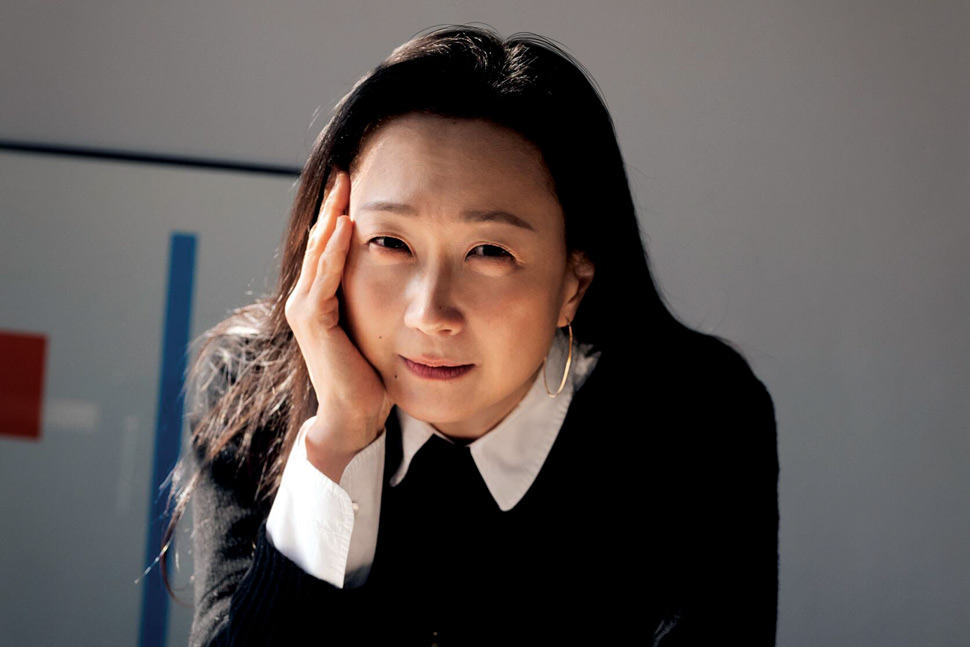
Min Jin Lee has notched career milestones that few authors reach. Her immigration saga Pachinko was both a National Book Award finalist and a New York Times Top 10 Best Book of 2017, and it was adapted into a television series of the same name for Apple TV. Lee is also a Guggenheim fellow and the first Korean American to hold the role of New York State author laureate.
Her latest title, American Hagwon (Cardinal, September), examines the influence of Korean “cram schools” among families in the Korean diaspora. American Libraries spoke with Lee ahead of her appearance at the American Library Association’s 2026 Annual Conference and Exhibition in Chicago. She discussed her new book, the library that shaped her, and her antidote to book bans.
What inspired you to focus on the education system as it relates to the movements of a middle-class Korean American family in American Hagwon?
My research process involved all these interviews—I’ve done hundreds of them, probably almost 1,000 at this point—and every single time I talked to somebody, they would mention their education path. It was such an important and controversial subject. I thought, if I had to think about the most important value for Koreans, especially in the diaspora, what would I write about? Education turned out to be a beast, because people have lots of feelings about it.
In the book, the Koh family loses wealth and status as they weather betrayal and financial crises. Do you see parallels between the events in your book and some of the forces at play in the world today?
At the beginning of Book Five of the novel, I have a quotation from a sociologist in Korea named Chang Kyung-Sup. He proposes this important idea called compressed modernity, in which you have a great deal of change happening in a tiny amount of time. That is the experience of Koreans, but it is also our experience in the technological industrial revolution that we’re having. I was really struck by having [the book] bracketed by two different financial crises: the 1997 Asian financial crisis and the global financial crisis [that started in 2007], set in America.
People are saying that there’s another one coming. If you happen to climb yourself out of poverty and don’t have generational wealth, and then you have these [crises], it is very hard. I wanted to write about that experience. How do you weather these economic and cultural shocks, in which you have almost no control except how you behave?
You spent significant time at Queens (N.Y.) Public Library as a child after immigrating to the US. What role did the library play in your life?
I don’t know if I would have learned how to read and write and speak English without the Queens Public Library and the kindness of librarians. It’s a place where I feel very normal. Libraries are spaces in which I feel like I’m okay. I didn’t always feel okay in schools.
You’re a former PEN America trustee and have been a vocal opponent of censorship. What do you make of our nation’s current wave of book bans, and what do you think it will take to pull through this moment?
This is ironic, but I think the reason why people want to ban books is because ideas are dangerous. Rather than thinking that ideas are dangerous, and therefore I’m dangerous, I should really remember that they are trying to ban us because we’re powerful. If you remember how powerful you are, you can stop the thing, rather than feeling hopeless or that we’re already defeated.
I know that organization works. If you take a long view on American history—and it’s not a very long history—Americans are local people. Because media has become so national, we forget about our local power. The local power is where we can take back the things that hurt our children.