Lois Lowry wants you to know that she’s “still kicking.”
“Tell me the truth, though—how many people saw my name in the program and thought, ‘I had no idea she was still alive’?”
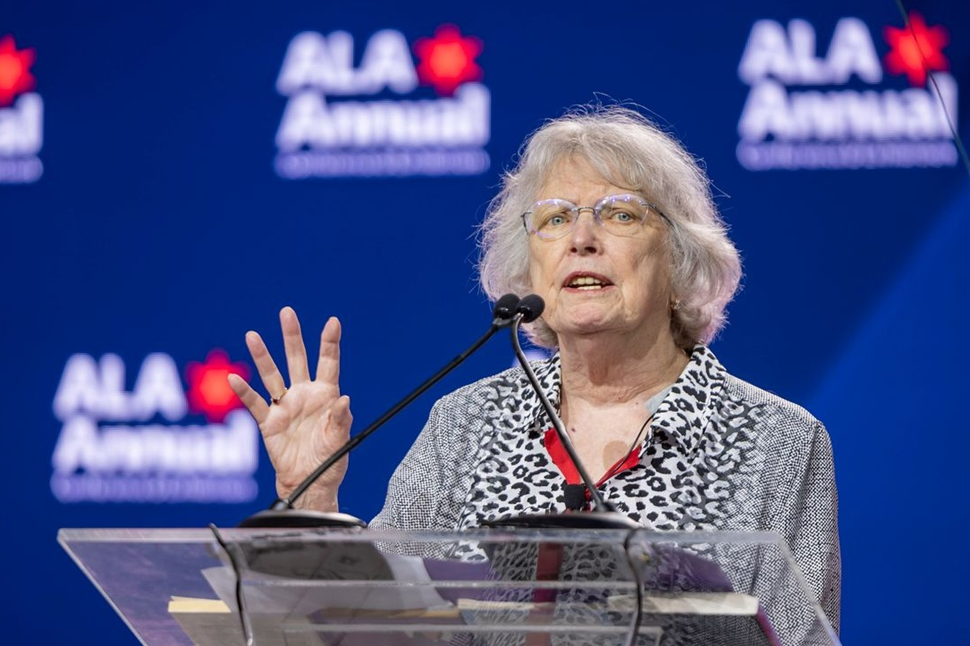
The 89-year-old author—twice a winner of the Newbery Medal, for The Giver and Number the Stars—took the stage to a standing ovation at the American Library Association’s (ALA) 2026 Annual Conference and Exhibition in Chicago on June 27. Lowry, who has written nearly 50 books for children and young adults and attended several past ALA conferences, likened her appearance to a homecoming.
“It is lovely to be back with what I think of as my family,” she said. “The Newbery Medal [for Number the Stars] was given to me in this city, at this convention.”
Lowry took the audience through a heartfelt and humorous retrospective of four of her books—A Summer to Die, Anastasia Krupnik, Number the Stars, and The Giver—sharing the inspirations, “dumb mistakes,” reader letters, and memorable people behind each these beloved titles.
A Summer to Die (1977), Lowry’s debut novel, was published after a short story of hers in Redbook caught the attention of a Houghton Mifflin editor. “I was a housewife who had yearned to be a writer,” Lowry said. “No one had ever asked me to [write a book].”
The novel, which explores a family’s grief after a daughter dies of a terminal illness, was inspired by the death of Lowry’s own older sister, Helen, at the age of 28. “Her story haunted me,” Lowry said. “Whenever any one of us goes through an event that changes our life but feels inexplicable, it haunts us.”
When the letters started pouring in from readers who had experienced losses in their own lives, “it caused me to become aware of how important literature is in the lives of children,” Lowry said. “This is something I could do.”
Her only regret about A Summer to Die?
“There is a very minor character who is a librarian, [Clarice Callaway]…. There is also a reference to Clarice Callaway walking down the street with a fistful of overdue slips in her hand—I apologize,” Lowry said, to uproarious laughter.
The Giver (1993), she explained, was also inspired by a lived experience. When Lowry visited her father, then in his 90s, in a nursing home, he couldn’t remember that her sister Helen had died.
“Going back to my plane that day, I thought, what if there was a way to manipulate human memory,” Lowry wondered, “so that one wouldn’t have to remember anything sad or frightening that had ever happened to you?”
After The Giver was published, Lowry received a letter from a 16-year-old named Noah, who had “devoured” the book.
“I am gay, I haven’t come out. My dad is a pastor, I live in the South, I think you get the picture,” Noah wrote to Lowry. “Your books make me feel something. I sleep the pain away…. [I want] to question everything, even if that means going against society’s norms.”
Lowry noted a common thread throughout the books she highlighted: for readers, they have provided a sense of comfort, a sense of compassion, a sense of choice, and a sense of connection.
She likes to end her books on a note of ambiguity, she said, as she did with The Giver and with her forthcoming YA novel, Building 903 (Clarion Books, September).
“There are questions that remain unanswered at the end,” Lowry said. “I think it’s important for readers to have things to wonder about.”