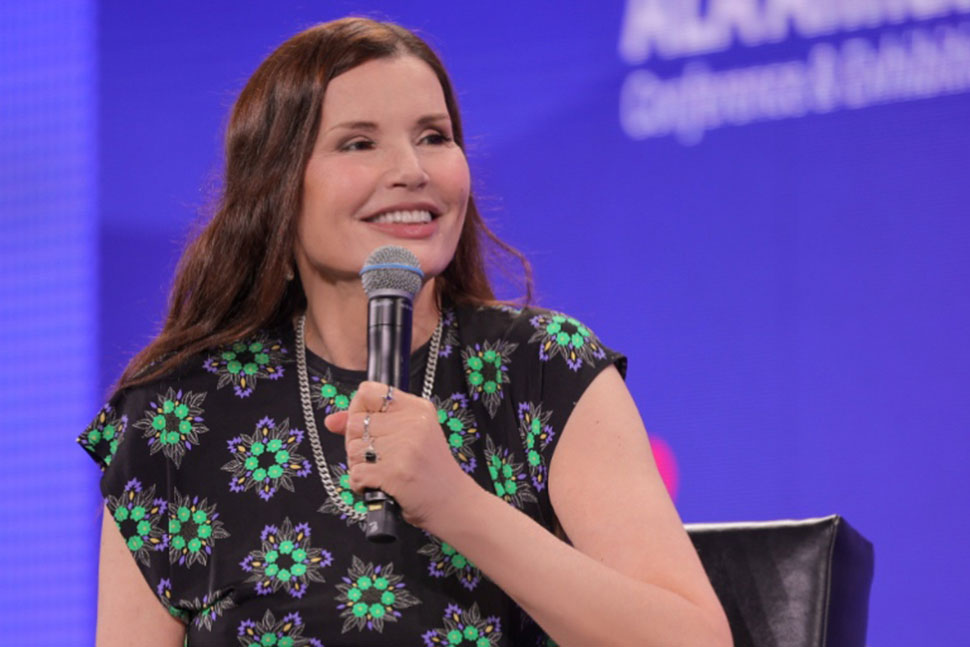
Academy Award–winning actor Geena Davis wrote and illustrated The Girl Who Was Too Big for the Page because she was “a tall baby.”
“I was very shy and self-conscious as a kid, and I never wanted to try anything,” Davis told the crowd at the Closing Session of the American Library Association’s (ALA) 2025 Annual Conference and Exhibition in Philadelphia on June 30. “My fondest wish was to take up less space.”
Her debut picture book (released by Philomel Books in April) follows a tall 4th-grader named Sheila who does not fit on the book’s pages. In the end, Sheila learns she just needed a bigger page, and accepts the traits that make her different.
Davis said that she herself gradually gained confidence from the characters she has played in film and on TV.
“I got cast in roles that were far more advanced than I was. It was like, fake it until you make it,” she said. “I wanted to play characters who were in charge of their own fate.”
Davis has embodied a lot of women on screen who fit that description, from Dottie Hinson in A League of Their Own to Barbara Maitland in Beetlejuice (“[she] was empowered”) to Valerie Gail in Earth Girls Are Easy (“even though I was in a bikini”). But it was playing Thelma Dickinson in 1991’s Thelma and Louise that changed her life.
“It exploded when it came out, we were on the cover of Time magazine. A lot of negative press, too—oh my god, now the women have guns!” Davis said. “This flipped a switch, and I became hyperaware of how women are depicted on screen.”
She later drew on this awareness in founding the Geena Davis Institute, a first-of-its-kind research and advocacy organization that examines equitable representation in media. The institute was founded in 2004, shortly after Davis’s daughter was born and she began noticing a lack of female characters in children’s cartoons.
“We are essentially conditioned from minute one to see girls as less valuable than boys,” Davis said. “If I was to get the research, I could go directly to the creators. I don’t have to educate the public, but they could be the beneficiaries.”
When Davis was able to take data from commissioned studies and show studio executives that, over a 30-year period, there were three male speaking characters for every one female speaking character, she said she got a universal reaction: “their jaws were on the ground.”
Twenty years in, the institute looks at all types of representation—race, ethnicity, body size, age, disability—across Hollywood and elsewhere. “People send us their scripts to analyze,” Davis said.
Before leaving the stage, Davis imparted kind words to the librarians in attendance and acknowledged their struggles.
“Your role is so invaluable. You are the custodians of the words that we all need,” she said. “Things are going to change at some point. But if you can hang on while we go through this, it’s invaluable to our world, our country, and our communities.”