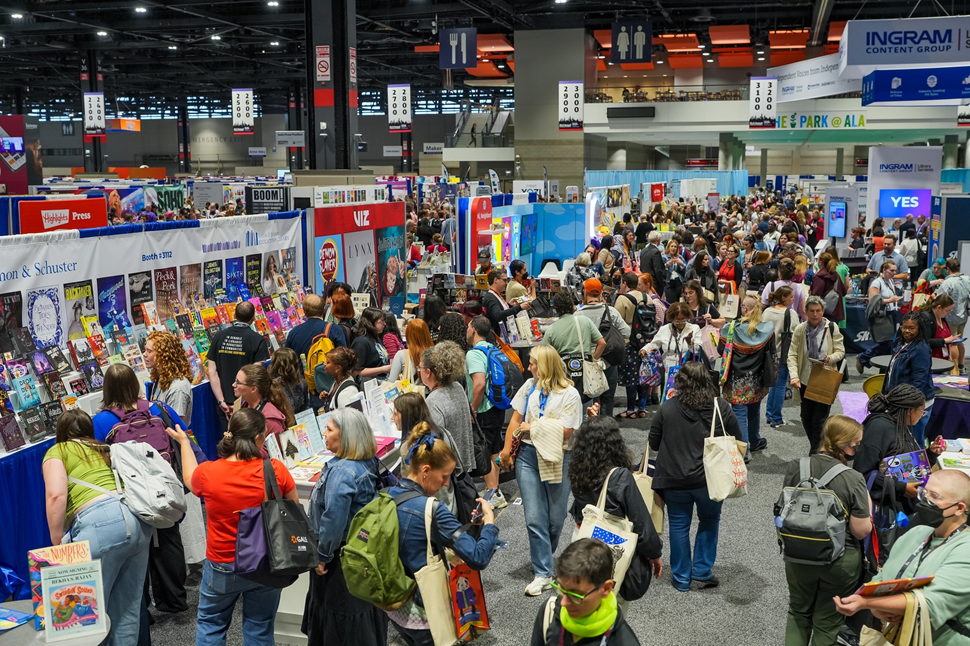
Chicago, headquarters of the American Library Association (ALA), was an apt host for the Association’s 2026 Annual Conference and Exhibition, marking both ALA’s 150th anniversary and the nation’s 250th birthday. A total of 14,800 people gathered at McCormick Place Convention Center for the event, held June 25–29.
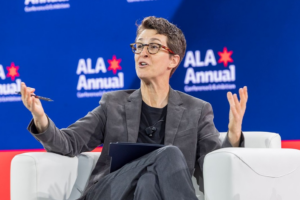
At the Opening General Session, journalist, author, and podcaster Rachel Maddow set the tone for a convening that was both celebratory and deeply reflective on what’s happening in the world. Shifting demographics, rapid advances in technology, and the rise of authoritarianism are all affecting how libraries serve their communities.
But libraries give Maddow cause for optimism. In their function as third spaces and hubs for storytelling, she observed, libraries have a big role to play in staving off fascism.
“We have an incredible set of moral cornerstones that we have to build on in this country,” she said, citing efforts like the civil rights movement. “I believe that inheritance is nourishment for us now. We have a lot of stories to remember and learn from.”
Reflections on democracy
Maddow wasn’t the only speaker to draw inspiration from the challenges of these times.
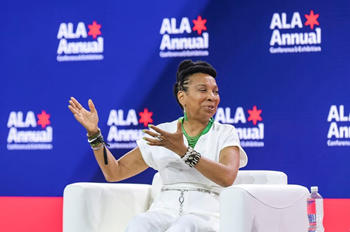
Civil rights scholar and professor Kimberlé Williams Crenshaw described her new memoir Backtalker (Simon & Schuster, May) as “the sum total of what it means to come of age … when most of us were born in a time of unfreedom.”
“We’re being told to accept things the way they are, take our dissent, and bury it,” she said, but people should be talking back to authoritarianism “if we believe we have a democracy worth saving.”
Min Jin Lee, National Book Award finalist for Pachinko and New York State’s first Korean American author laureate, talked about her forthcoming novel, American Hagwon (Cardinal, September), and the power of books and libraries.
“I think it’s the most romantic thing I could say, but my life has been liberated by public education,” she said. “I do think that books have always been this kind of fortress in which we can save democracy.”
The conference’s Closing General Session featured a panel of ALA leaders discussing the current landscape of intellectual freedom.
“We’re admittedly in a challenging time,” said Sarah Lamdan, executive director of ALA’s Office for Intellectual Freedom (OIF), citing record-high book bans and reports of hostility directed at library staffers. What most people don’t see, she said, “is the emotional toll that that takes on library workers.” Yet the first thing Lamdan and her OIF colleagues tell those who turn to them for support is this: “You are not alone.”
Then–ALA President Sam Helmick emphasized that any form of support—whether testifying in support of legislation, volunteering, donating, or keeping your doors open—is meaningful.
“If your access point is being the best damn librarian you can be, that is enough,” Helmick said. “Democracy happens because we’re participating on some level.”
Coexisting with the machine
Unsurprisingly, the spread of generative artificial intelligence (AI) remained a hot topic across sessions. But where past conference discussions have often focused on tempering hype with caution, this year’s discussions focused on more nuanced questions about implementation and ethics.
At the annual Top Tech Trends panel, Nicole Steeves, library technology director at Chicago Public Library, highlighted real-world situations where AI may or may not be appropriate.
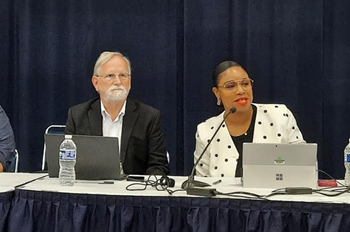
In reference services, for example, “AI doesn’t have the skills of a human, and it doesn’t have the judgment of a librarian.” But the technology shows promise in uses like real-time translation, particularly for libraries serving linguistically diverse neighborhoods, like Chicago’s Rogers Park.
A recurring message at “Ethical AI in Libraries: A Critical Look at the Potential and Promise” was that libraries need to develop AI guidelines, whether or not they choose to adopt the technology into their workflows.
“Disengagement from AI guarantees your vulnerability,” said panelist Michael Hanegan, founder of the Center for the Future of Learning and Work. This is particularly important, he said, when it comes to teaching media literacy. “The people that you serve will be harmed without your trusted guidance.”
Independent consultant Marshall Breeding, editor and writer of Library Technology Guides, spoke on both panels. He described the spread of AI as “inevitable” as vendors are increasingly integrating the technology into their products, but “we have to push back and make sure [AI] continues to be optional.”
A land of pure imagination
Several panels and featured speakers touched on how to connect with younger audiences and foster connection through play, creativity, and storytelling.
In “Pokémon Club @ Your Library: Engaging Young Learners through Play and Community,” panelists reported on ALA’s new partnership with The Pokémon Company International, which has brought club programming to 730 public and school libraries since its launch in October 2025.
“Offering the club as a hands-on activity is such a great thing,” said Karyn Lewis, teacher librarian at Memorial Parkway Junior High in Katy, Texas. “Administrators are vocal about wanting less screen time, and parents also like to know that their kids are not going to be in front of a screen.”
Daniel Patron, library associate at Chula Vista (Calif.) Public Library, uses it as a teaching opportunity. One presentation introduced The Three Musketeers, for example, by discussing the Pokémon that are based on characters from the 1844 novel. “Seeing it through a Pokémon lens makes it something they can grasp,” Patron said.
More broadly, “For Every Player Their Game: Winning Strategies for Recommending Games” focused on the emerging practice of players’ advisory, similar to traditional readers’ advisory but with subtle differences.
While some games can teach historical content (one panelist recommended Votes for Women, a board game about the women’s suffrage movement), many are equally valuable for developing strategy, problem-solving, and other metacognitive skills.
It’s also about trying new things. Molly Porter, manager of the Dutchtown branch of Ascension Parish (La.) Library, described a teen patron who joined her Dungeons & Dragons campaign.
“They were good with the mechanical stuff, but they really ran with more role-playing elements.” She steered him to Snake Oil, where portraying zany characters is central.
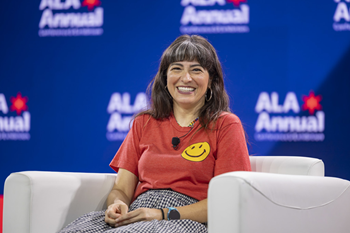
Comedian and Saturday Night Live alum Melissa Villaseñor said characters and creativity have always been part of her life, and embracing individuality is a central theme in her forthcoming children’s book, Cat and Lola: School Picture Day (Gloo Books, September), with illustrations by Jimena Sánchez Sarquiz.
She encouraged young people to experiment with different avenues of creativity: “You will stumble upon something that really lights your soul,” Villaseñor said.
She’s made a career out of making audiences of all ages laugh, but there’s something special about performing and writing for children, she said. “I love making adults laugh, but when you make a kid crack up, that means you’re real funny, because they tell the truth.”
Two-time Newbery Medal–winning YA author Lois Lowry talked about fostering heartfelt connections with readers while reflecting on some of her best-known novels, including A Summer to Die, her 1977 debut. It explores a family’s grief after a daughter dies of a terminal illness—inspired by the death of Lowry’s own older sister—and the younger sister’s coming-of-age.
When the letters started pouring in from readers who had experienced losses in their own lives, “it caused me to become aware of how important literature is in the lives of children,” said Lowry, who would go on to write nearly 50 books for children and young adults. “This is something I could do.”
Thoughtful programming and services
Several events highlighted resources for supporting and engaging specific age and interest groups.
Attendees heard from the creators of programs including a successful career and financial literacy workshop for teens at Plano (Tex.) Public Library (“Career Quest: Engaging Teens with their Future Careers”) and a training program for beauty entrepreneurs at Brooklyn (N.Y.) Public Library (“Breaking Barriers, Building Brands: Supporting Beauty Entrepreneurs in Libraries”). Both sessions highlighted the importance of responding to community needs and forging partnerships to stay relevant and build credibility.
The panel at “Elders Deserve Social Justice Too” offered tips and resources for libraries looking to improve their services for a growing population of older adults.
Julianne Novetsky-Welsh, outreach coordinator at Warren (Mich.) Public Library, suggested libraries create senior or older adult advisory boards, similar to teen boards. Programming for young people is often broken down into specific age groups, she pointed out, “but when it comes to adults, basically once you’re 18, it’s all lumped together.”
As libraries continue to evolve their programming and services, some sessions addressed the importance of workplace safety and wellness.
The “‘That Guy’: Addressing Patron Sexual Harassment in Reference Services” session described how creepy callers exploit a workforce trained to be helpful and nonconfrontational, a culture of intellectual freedom that discourages judgment of patron requests, and the distance and anonymity of phone and chat services.
Panelists recommended encouraging employees to trust gut feelings and document patterns of behaviors and the feelings they create, as well as empowering them to say no to unreasonable requests.
“It’s very difficult to turn off ‘service mode,’ but we want librarians to feel supported,” said Ann McIntire, information services supervisor at Prince George’s County (Md.) Memorial Library System.
Leading from the heart
Former First Lady Jill Biden spoke about her new memoir View from the East Wing (Gallery Books, June) and reflected on balancing her roles as educator, mother, and cancer prevention advocate.
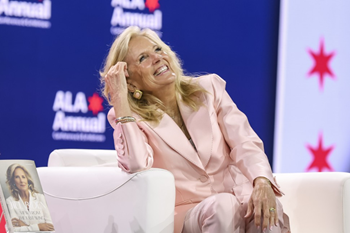
Biden remained a full-time community college professor during her time as second and later first lady, becoming the first presidential spouse to maintain an outside career, while leading efforts to update the White House library’s children’s section and managing cancer awareness campaigns.
“I say to my students all the time that we have to commit ourselves to the act of kindness,” she said. “I think Joe [Biden] was elected because he was an empathetic leader.”
Closer to home, longtime member leaders talked about leadership within the Association at “Leading ALA into the Next 150 Years,” highlighting the variety of ways to participate (round tables, task forces, and more) and the role of mentors in cultivating leaders.
“A lot of people associate leadership with starting something new, like two guys in the garage inventing Apple computers,” said Karen Schneider, retired librarian, former ALA Executive Board member, and chair of ALA’s Committee on Organization. “Leadership can look like renovation, reuse, reimagining—it can look like showing up.”
Council Matters
ALA Council took the following steps during its three meetings at Annual:
- Approved a three-year moratorium on establishing new divisions, round tables, and standing committees—a way to help the Association address fiscal struggles and membership decline and give staff a chance to navigate its recent unionization (CD#27.1).
- Adopted The Librarians’ and Library Workers’ Bill of Rights as an official statement of principle and practice (CD#50).
- Passed the Committee on Legislation’s resolution affirming public libraries as essential economic and civic infrastructure (CD#20.1).
- Accepted the Artificial Intelligence (AI) Working Group AI Guidance for Libraries document (CD#44.2).
- Resolved that library card access is a fundamental right and called for further study on how library card access policies can prioritize social equity (CD#51).
- Heard about ALA’s finances, including its Structural Deficit Closure Plan, a five-year process to bring ALA out of its multimillion-dollar deficit (CD#13.6).