
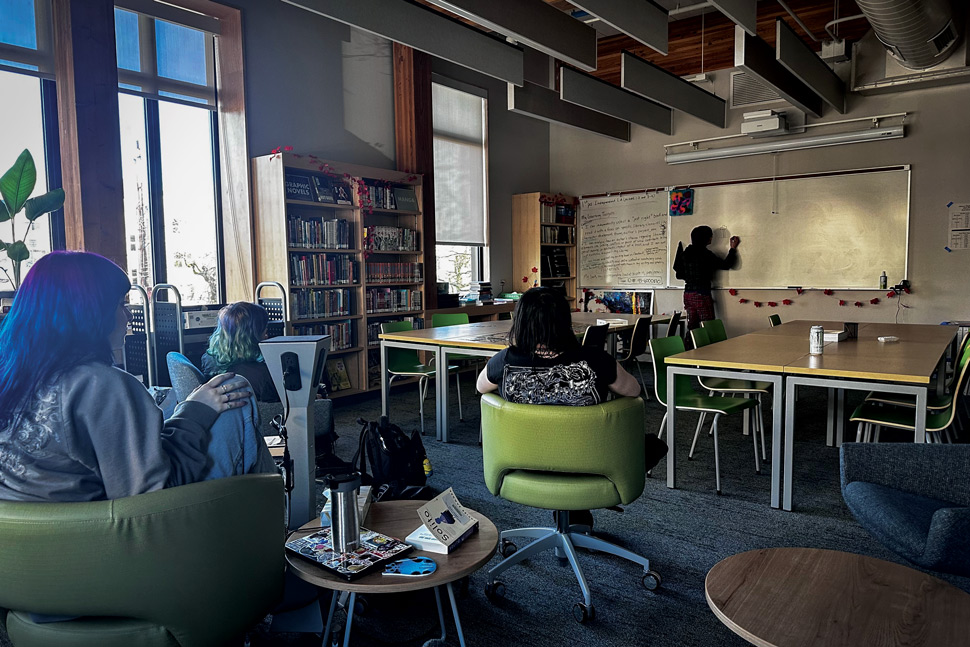
Since fall 2024, each school day at Grant High School in Portland, Oregon, has started the same way: Roughly 2,100 students line up to place their phones in gray and green Yondr pouches—the kind live performers use to prevent audience members from recording—as they enter the building. From the morning bell to dismissal, phones are sealed and can be unlocked only with special magnets near the school’s exits as students leave for the day.
The high school’s effort to limit phone use on campus has received support from its educators, who say classroom engagement is on the rise, and mixed reviews from students, who dislike being cut off from
their devices. But there’s been one unexpected outcome of the policy: More students are spending time in
the library, where they’re browsing the collection or hanging out during free periods, says teacher-librarian Paige Battle.
“They’re checking out more books, and I feel like that’s been so important in their education,” Battle says. “We’re seeing studies about students, even adults, not having the reading stamina they’ve had in the past, so I’ve been encouraged by this increase.”
Roughly six in 10 parents of an 11- or 12-year-old say their child owns a smartphone, according to a 2025 Pew Research Center survey. And as more schools across the country enact phone-free policies—29 states and the District of Columbia have instituted bell-to-bell phone-free policies so far—many school libraries are experiencing a surge in popularity.
Grant was one of the first schools in Oregon to ban cellphones in 2024; the board of Portland Public Schools (PPS) followed suit the next year with a districtwide limit on student phone use across all grades, including during lunch and free periods. “The research is clear: Cellphone use can create a trifecta of consequences for our young people—mental health issues, [less] safety in school, and distraction from
learning,” said Oregon Gov. Tina Kotek in a statement after she signed an executive order in July 2025. The order requires every school in the state to enact a policy banning phones during school hours. “I signed this order to stand up for the promise of every student in every corner of the state.”
During the first semester that Portland’s phone ban went into effect, PPS saw a 15% increase in library circulation, says Julie McMillan, another teacher-librarian in the district. That increase dwindled to about
2% districtwide over the following months, but McMillan notes that checkouts remain high at secondary
schools, where the cellphone ban is likely to have a greater impact.
Battle recalled a group of 9th-graders who would hang out in her library every day, sitting together with their eyes on their phones. The following year, when they had to put their phones away, the group kept sitting together in the library, but now they were talking to one another.
“That really warmed my heart, because I thought, ‘This is fabulous. You’re actually conversing with one
another in community,’ ” Battle says. At Irma Lerma Rangel Young Women’s Leadership School, a middle and high school in Dallas, students also keep their phones sealed in Yondr pouches. When the new policy began last fall, following a ban on cellphones in schools across Texas, librarian Christene Estrada saw book checkouts increase by 72%.
Godgift Igwe-Icho, a 10th-grader who volunteers at Irma Rangel’s library, has noticed more students spending time there each week. “Instead of just being on their phones or just talking, they have actually checked out books,” Igwe-Icho says. “When I come into the library and help Ms. Estrada reshelve books, there [are more] books that I need to reshelve than before.”
This year, Estrada has seen a stronger culture of reading, especially among 6th-graders new to the school.
“As [they] get older, the tendency is [that] kids have more important things to do, or the library is not as cool as it used to be,” Estrada says. “But if someone is super passionate about reading in 6th grade, they tend to consistently read after that.”
Some librarians are working to meet the needs of these young readers. When Waynflete School, a private college-preparatory school in Portland, Maine, implemented a phone-free policy this school year, middle school librarian Sam Stuart wanted to give students something to do, now that their cellphones were dropped off in their homerooms for the duration of the school day.
He expanded the graphic novel and Japanese manga section, adding about 200 books to the shelves with a grant from the Association of Independent School Librarians. Stocking more of these visual, short books that already had high demand gave students more to read between periods.
“I wanted to give them something that really is like, ‘Hey, the library is your space … I’m happy to get the books that you are interested in,’ ” he says.
Stuart has noticed more middle schoolers using the space during study hall and office hours, and he’s stocked more board games and puzzles for them. “It is nice to be in the library. Kids [are] actually socializing or doing work instead of just being on their phones,” he says.
At Grant High School in Oregon, Battle has assigned students in her library assistant internship class to create shelf talkers with blurbs and art to display, highlighting books that resonated with them.
She also holds quarterly book clubs and monthly lunchtime trivia competitions to quiz students on classroom curricula and current events. A few of Battle’s students even formed a pen pal club last year to exchange snail-mail letters with students at another school.
As districts consider smartphone rules, Battle advises school librarians to plan ahead. If schools ban or limit students’ phones, she says, “What are you going to offer kids in their stead?”