
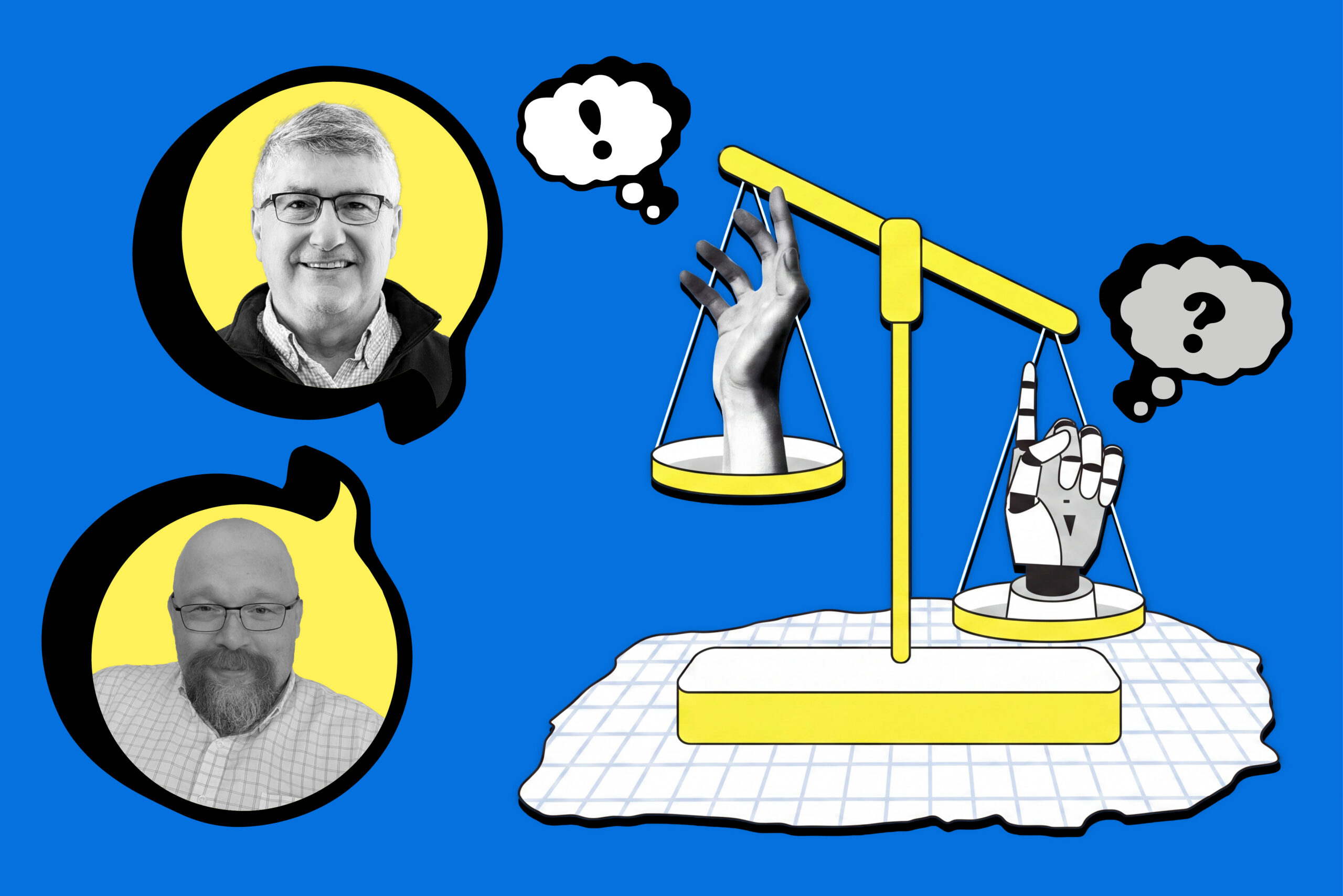
In response to the proliferation, and polarized response to, of the use of artificial intelligence (AI), ALA designed its Guidance on the Use of AI in Libraries to help institutions develop AI policies and procedures with professional values in mind. ALA Council adopted the guidance document in June at ALA’s 2026 Annual Conference and Exhibition in Chicago.
“It’s not meant to be a ‘Here’s what you do,’” AI Policy Working Group cochair Chip McAuley said of the document. “It’s ‘Here’s what to consider.’”
McAuley, reference librarian for Hamilton Township (N.J.) Public Library, led the working group that developed the guidance alongside Ed Sanchez, head of library IT at Rayner Library at Marquette University in Milwaukee. American Libraries spoke with McAuley and Sanchez about the origins of the guidance and how the working group aimed to represent library workers with varying perspectives on AI use. The interview has been edited for space and clarity.
How was this guidance developed?

McAuley: It started out as something the Information Technology Advisory Committee (ITAC) was tasked with, looking at AI in terms of how it connects to ALA and its committees. ITAC created a vision statement, which we presented to ALA Council at the 2025 Annual Conference in Philadelphia. We then received the authorization to do the AI Policy Working Group.
The goal of the working group, which I feel we did achieve, was to provide libraries with philosophical and practical guidance as they’re working on or revising their own guidance documents. If you choose to adopt AI in some capacity, consider these various aspects, and use your own judgment in applying them.

Sanchez: It became apparent to us that we’re not providing a positive document for adoption of AI, nor are we saying that AI should be refused. But we’re trying to establish a balance between adoption and reasoning to discontinue or not use AI.
Considering a delay or the removal or discontinuing the use of an AI product is—and we say this in the document—an affirmative professional choice grounded in library values and not a failure of adoption. We wanted to give librarians across the US the understanding that their values are important.
McAuley: We had 30 magnificent working group members from all aspects of librarianship, and from all viewpoints on AI. We had people who were incredibly against AI, incredibly for AI, people in the middle, people who were skeptical, and I think that’s part of why this document works so well.
The guidance uses ALA’s core values as a structural framework. How did the core values influence this work?
Sanchez: At the outset, there were so many possible frameworks that we could have looked at in terms of AI. Libraries are technology-focused organizations. We asked, is AI a continuing technological advancement? Or is it something completely new? We decided to opt with what we already know and value as librarians, especially in the case of AI being something that could become very unsettling to information-seeking behavior.
Despite the variety of opinions on whether and how to implement AI, was there anything you found the working group members all agreed on?
McAuley: I think there was an underlying feeling of the fact that libraries are inherently human-centered places, and in putting forward any form of guidance, it had to be guidance that had a human-centered focus and a harm reduction lens. We kept the document human-centric with the concept that AI should only be used as a tool and never, for instance, to replace a library worker. I think ALA and the profession as a whole should commit to the human-centric library. We need to commit to making sure that not one library worker loses their job because of automation or AI.
What role does this guidance play in helping libraries develop and frame AI-related educational programs or resources for patrons?
McAuley: It is the difference between AI evangelism and AI literacy, and I think all library workers are going to be at the front line of that. It’s AI literacy that we want to focus on: a critically informed approach to teaching fundamentals and meeting the public or students halfway. They’re going to be coming with certain needs, and there are going to be general aspects of AI that everyone needs to know about.
We’re not in the business of promoting technology, but, just like what we’ve been doing with information literacy for decades, we want people to understand the tools that they’re using, how to use them, and the ethical implications of their use. We want patrons to know, for instance, if you put your private medical information into a large language model (LLM), it’s then going into the hive mind of the database. From a librarian’s point of view, make sure that the patron understands what happens when you do that. If they want to do that, that’s up to them.
Sanchez: The idea of privacy is central to what we are trying to bring forward in the document, not only in terms of personal data, but the prompts that patrons, students, and others put into AI are almost their own intellectual property being shared and used. The idea that who we are and our habits are increasingly becoming a data point for systems is something that the document is trying to call out.
I think listening to our students or patrons in libraries, and trying to understand where they’re coming from, is important. I’m not sure that all young people are on board with the whole idea of AI, and I think that their voices need to be heard. The document stresses that comparable, non-AI literacy information needs to be provided by librarians, particularly for those who are not interested in using AI.
How can libraries use the document’s ethical frameworks to determine whether to use AI and which platforms or applications to use?
McAuley: I think it depends on where you wear your ethics. Take the environmental aspect of it: Here in New Jersey, we have 80 data centers. With the various environmental impacts those have, now you are seeing pushback across the country on these data centers as people learn more about them. If you’re someone whose main focus is the environment, you could say, “Supporting one of these data centers, until they have a green design, is unethical.” But then you look at so many technologies that we use, such as cars, damaging the atmosphere, and you can say, “Where’s the ethical compromise?” Giving people an ethical underpinning was the main point of the document, so if you choose to employ it, just be aware of all the different aspects of what it means to adopt.
Sanchez: It’s difficult for one library to push back against Silicon Valley. But if we group together—libraries, educational institutions, and library associations—our collective voice is something that can be heard on a larger scale. The values that exist in Silicon Valley are not the same shared values that we have in education, in libraries, and so forth. We have to find a way to harmonize those if these tools are going to remain useful to us.
You’ve described this guidance as a living document. Are there developments that you hope or expect to see addressed in the future?
Sanchez: There are pieces that are missing from this document that we’ve talked about. There is no section in the document specifically related to copyright and the fact that the harvesting of copyrighted materials by LLMs is considered fair use—and the influence of that on intellectual freedom. There’s a lot more to be said about intellectual freedom and the use of AI.
AI, in a large sense, has been trained on a largely English, white, Western-focused dataset. I’d like to know how it is going to evolve to encompass additional cultural and language information. Looking at it from a diversity, equity, inclusion, and accessibility perspective, I think we need to ask the question of AI developers again and again: Who is being used for training the data? What impact is this having on other cultures, other countries, and the use of labor? Not just the impact on librarians and so forth, but what is disclosed about what each of these large companies is doing to create and train their new systems?
McAuley: It all goes back to the people first. The main thing is ensuring the people who are doing the programming are taking an ethically sound, diverse approach to the construction of the applications.