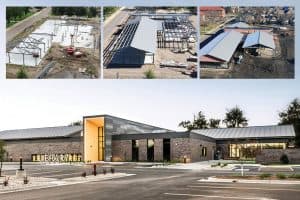
After serving its community for nearly 45 years in the same building, Escondido (Calif.) Public Library closed in April 2025 for an $11.6 million renovation. It was important to us, as the city’s lone library, to preserve access during construction. So one month later, our library opened a temporary location in a very different kind of facility: the nearby North County Mall, where services and collections were spread across six storefronts, including a former Abercrombie & Fitch clothing store.
Of course, moving a library takes more than a month. Our planning took more than a year and required staff to work under tight deadlines, limited budgets, and high expectations. Here’s how we did it, and what we learned from the process.
Choosing a location. It’s essential to consider whether the new location will match, improve upon, or limit access. Retailers and mall operators have already studied traffic patterns, visibility, parking, and nearby amenities. Leverage that knowledge to evaluate access. In our case, the public benefited from a highway and bus stop near the mall, and adjacency to a city park. The arrangement also gave the mall a stable civic tenant and created natural cross-traffic between library patrons and shoppers. The mall was not just available space; it was a location where public access, economic development, and community visibility could overlap.
When selecting mall space, prioritize outside access, a single contiguous footprint, and a ground-floor location for accessibility. Because our location lacked outside access, we had to adjust our hours to fit the mall’s schedule. (We added book drops outside the building to help patrons return items efficiently.) And because of site availability, our services were spread across multiple storefronts, which added confusion and limited collaboration. Clear signage, consistent staff talking points, and patience at service desks became essential as patrons learned which storefront housed which service.
Moving your collection. We aimed to preserve as many collections, programs, and services as possible, even while reducing public space from 40,000 to 15,000 square feet. To know what fits, you need to know what you have. Collections management and evaluation tools, such as LibraryIQ and collectionHQ, are highly useful when relocating.
Floor plans and item counts helped us calculate what percentage of collections could fit. Only the most popular items made their way to the browsing collections; the rest went to storage.
The setting had changed, but the library’s role had not.
If the timeline is short or the budget is tight, consider renting shelving rather than buying. We rented 200 six-shelf wooden carts, which cost half as much as purchasing mobile shelving. Our existing furniture and equipment helped re-create play, study, and computer areas. The most costly purchases for the move were the two book drops ($16,000) and lumber used for retail shelves ($10,000).
Maintaining library operations. Cultural events and storytimes moved to the mall plaza, where shopping families—sometimes on their way out of the nearby coffee shop or Old Navy—stopped to join. Mall management was helpful as we planned and promoted events, though ambient music sometimes pushed programs into the community room included in our lease, where we also held smaller info sessions and other events. Keeping familiar programs on the calendar helped reassure patrons that the setting had changed, but the library’s role had not.
Meanwhile, patterns emerged: New releases moved quickly, average checkouts per visit rose from seven to 10, library card registrations grew 40%, and patrons came from more neighborhoods. This reinforced what staff intuited in selecting the space; the mall acted as a regional attractor. Yet total circulation never caught up with what we saw at our home library, likely attributable to having less browsing space.
The library returned home in August with new meeting rooms, a café, a makerspace, tween and teen spaces, and other improvements. Still, the public loved their makeshift library enough to ask that we open a permanent branch at the mall. Whether that happens will depend on funding and continued support. Our year at the mall reminded us that libraries are defined less by their buildings than by the access, services, and relationships they carry into the community.