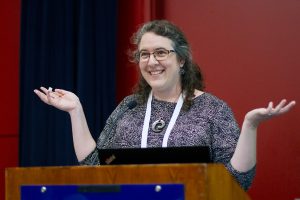
Sam Helmick recalls the first moment intellectual freedom played a role in their life. The immediate past president of the American Library Association (ALA) said they grew up in a fairly conservative and “redacted household,” where they remember taking Peter Benchley’s novel Jaws from the family library out to the backyard to hold up to the sun to read what was written behind the black Sharpied-out sections.
“I was trying to pierce through with the light to understand what was being hidden from me,” Helmick said. “Because subsequently, for many decades, I was the result of what to think versus how to think, and that ideas should not be engaged with because they could be dangerous.”
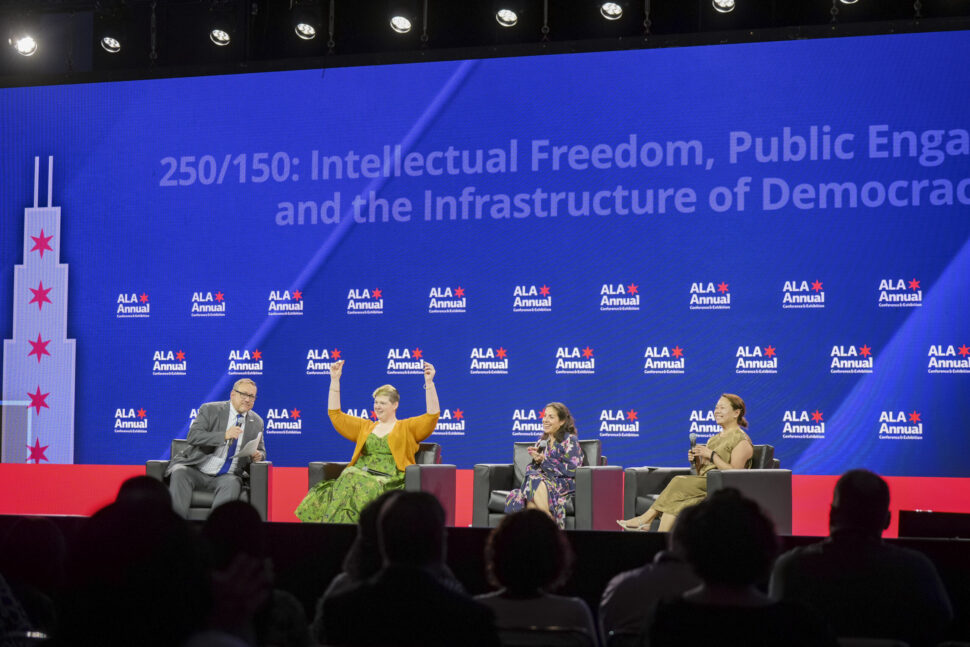
With intertwining milestone anniversaries—the nation’s 250th and ALA’s 150th—ALA Executive Director Dan Montgomery sat in conversation with Helmick, ALA President Maria McCauley, and Office for Intellectual Freedom (OIF) Executive Director Sarah Lamdan on June 29 at the Closing General Session of ALA’s 2026 Annual Conference and Exhibition in Chicago.
They discussed the current state of intellectual freedom, where it’s headed, and how to connect it to our other freedoms and to democracy. The key message? There is plenty of hope and joy to draw from.
“We’re admittedly in a challenging time,” Lamdan said. This past year saw the second-highest number of challenge attempts in the 35 years OIF has been tracking this data. (The highest number of book bans was in 2023.) What’s more, there continue to be reports of intimidation, threats, and harassment directed at libraries and library staff. From this, what most people don’t see, she said, “is the emotional toll that that takes on library workers.” Yet the first thing Lamdan and her OIF colleagues tell those who turn to them for support is this: “You are not alone.”
Coalitions are especially critical, Helmick said, “because you need to be able to speak to other practitioners in the First Amendment space,” like authors, artists, publishers, and religious organizations. “We need to tailor our advocacy and awareness conversations,” they said, similar to how library workers conduct reference interviews.
When Lamdan hears a community is experiencing a book challenge, the first thing she thinks is, “Who can we bring to rally around these people? Who can we bring out in joyful support of libraries?”
McCauley highlighted the recent passage of the Massachusetts Freedom to Read Act in the state House, which brought together various coalitions to advocate on behalf of libraries and library workers. “Our democracy is stronger and healthier thanks to our libraries,” McCauley said. “For me, library work is justice work.”
But how do library workers serve as warriors for democracy while also running the day-in, day-out of their tasks? Helmick said any participation—whether testifying in support of legislation, volunteering, donating, or keeping your doors open—is meaningful.
“If your access point is being the best damn librarian you can be, that is enough,” they said. “Democracy happens because we’re participating on some level.”