
Michael Hanegan, founder of the Center for the Future of Learning and Work, described a scenario that might be frustratingly familiar to information professionals: His mom often falls for deep fakes. She came of age in a time when people were told to believe their eyes and video was considered an unimpeachable medium, and she’s unaware of what generative artificial intelligence (AI) is capable of.
Knowing that some librarians are thinking about ignoring AI completely, Hanegan had a thought: “What institution is going to help [my mom] and all of her friends navigate this?”
“Disengagement from AI guarantees your vulnerability,” he said. “The people that you serve will be harmed without your trusted guidance.”
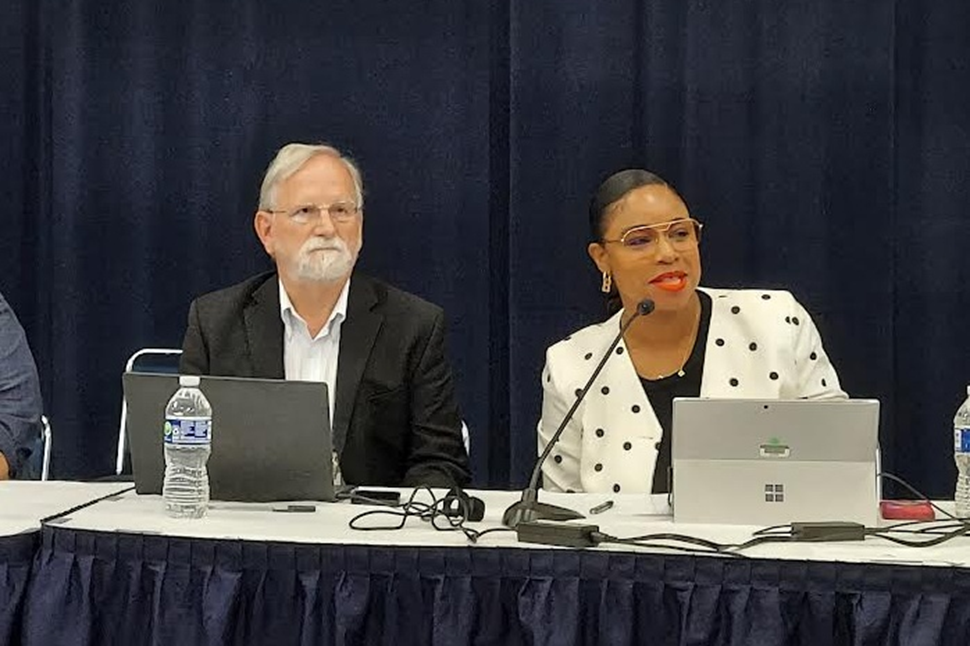
Hanegan was one of four panelists who spoke at “Ethical AI in Libraries: A Critical Look at the Potential and Promise” at the American Library Association’s 2026 Annual Conference and Exhibition in Chicago on June 28. The panel, moderated by Micah May, director of business development at Lyrasis, offered suggestions for how libraries can navigate the ethical implications of generative AI, even if they choose not to use it in their workflow.
“Regardless of whether you adopt AI or not, [you should] have guidelines,” said Brandy McNeil, deputy director of branch programming and services for New York Public Library (NYPL) and Public Library Association president.
McNeil said libraries should carefully weigh whether AI tools are inclusive, accountable, human-centered, transparent, and protect privacy.
“When [vendors say they use] industry standard practices, which standards? When they say they anonymize data, how? Which fields are removed?” McNeil asked. “Those are some of the things you want to be concerned about.”
The spread of AI is “inevitable,” said Marshall Breeding, editor of Library Technology Guides, as vendors are increasingly integrating AI technology into their products. But, he said, “we have to push back and make sure [AI] continues to be optional.”
“Vendors are part of our community, a lot of them are librarians themselves,” Breeding said. Libraries should be asking them the tough questions before they sign a contract: “What is the data flow? Is information walled up from the broader universe? If you’re dealing with a vendor that has lots of products and lots of spaces, how does that flow through their ecosystem?”
Get it all in writing, Breeding cautioned. “You need to understand ahead of time before you sign on the dotted line.”
One phenomenon in the generative AI market is that companies claim to be open source, said Peter Musser, head of library services at the Institute for the Study of Knowledge Management in Education.
“The use of the word open [as in OpenAI] is very intentional, because folks love open source,” Musser said. “They want that trust—it’s marketing.”
But true open source would mean four things, he said: that the AI can be used for any purpose without having to ask for permission, that you can understand how results were created, that the AI can be modified, and that the AI is open for sharing.
While Musser said there are examples of open source AI, such as image recognition and pattern recognition tools, they aren’t ones associated with large language models.
“None of the big models that we talk about—not Gemini, not Claude, not ChatGPT—none of those are open,” he said. Libraries looking to avoid these big models should try engaging with local universities that may already be developing their own tools, he suggested. “If we don’t, we just have to go with what vendors are offering.”
As for the many patrons who come into libraries with questions about AI?
McNeil said that libraries have an opportunity to provide patrons with digital literacy classes and community conversations around the technology. At NYPL, for example, librarians have educated patrons on the perils of letting AI write their cover letters and résumés unchecked.
“I can’t stress this enough—it’s not about your library system adopting AI,” McNeil said. “We have to focus on giving our patrons agency.”