Nearly 1 in 5 people in the US is 65 years or older. Globally, older adults now outnumber those 5 years and younger for the first time in history.
As this population continues to grow, the need to combat age-related discrimination must grow with it, said presenters at “Elders Deserve Social Justice Too,” a June 28 session of the American Library Association’s (ALA) 2026 Annual Conference and Exhibition in Chicago.
With advances in technology and medicine that have extended the average lifespan, “this is something that’s going to affect all of us,” said presenter Joseph Winberry, assistant professor at University of North Carolina at Chapel Hill’s School of Information and Library Science. “This is going to be a defining issue for most of our careers.”
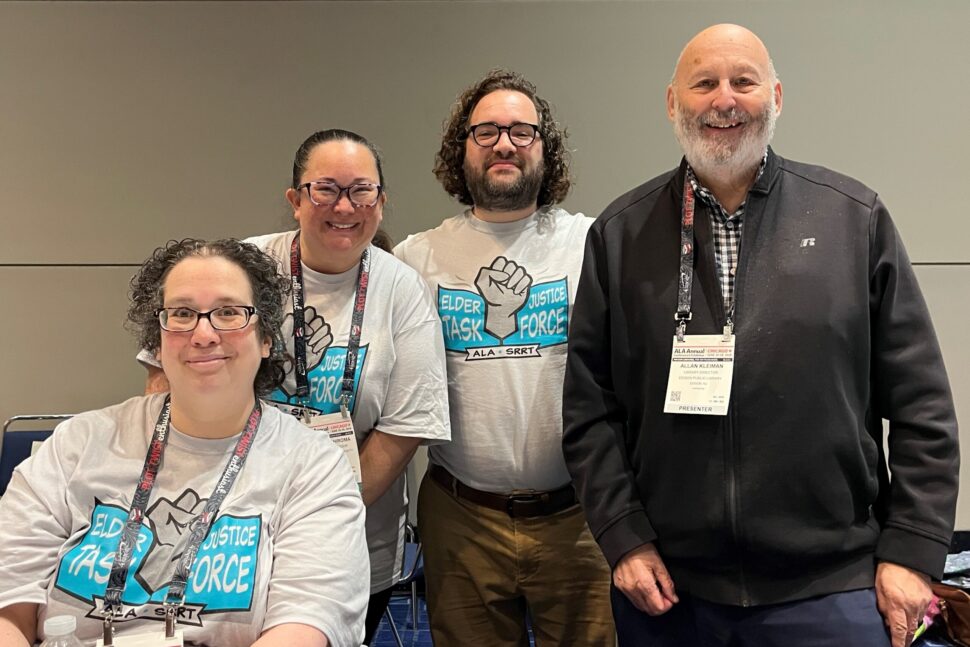
Winberry was joined by Allan Kleiman, director of Edison (N.J.) Public Library; Julianne Novetsky-Welsh, outreach coordinator at Warren (Mich.) Public Library; and Kristina Shiroma, assistant professor in the School of Information Studies at Louisiana State University in Baton Rouge.
Modeling anti-ageism
When it comes to age discrimination in the workplace, Shiroma said it can manifest as preferential treatment toward younger employees in job selection, promotion, personal and professional development, forced redundancies, and performance reviews.
“There is really no difference between actual discrimination and perceived discrimination,” Shiroma said. “It’s all discrimination.”
So how can libraries and library workers make change? The presenters said modeling anti-ageism starts with reflecting on our own feelings about age (for example, by catching ourselves when joke about “senior moments” and the like) and bringing a “with and for” collaborative approach rather than a top-down model of doing for others or studying about others.
The nonprofit Project Implicit offers online assessments to help identify biases and gaps in understanding, and sites like Age without Limits provide a free age-positive image library. Learning from and partnering with groups—like the Diverse Elders Coalition and local offices on aging that receive federal funding through the Older Americans Act—can be beneficial as well.
Not a monolith
Novetsky-Welsh spoke about her work auditing ALA’s website on behalf of the Elder Justice Task Force, part of ALA’s Social Responsibilities Round Table (SRRT), with the goal of examining how older adults are represented across the Association. To improve representation, she recommends using age-positive language and imagery, increasing visibility of related resources and committees, and creating more opportunities for older adults to serve as leaders, presenters, mentors, and advisors.
Elders are not a monolith, Novetsky-Welsh cautioned. She suggested libraries create senior or older adult advisory boards, similar to teen boards. Programming for young people is often broken down into specific age groups, she pointed out, “but when it comes to adults, basically once you’re 18, it’s all lumped together.”
Looking back, looking ahead
Kleiman’s involvement in older adult services spans 40 years. He discussed ALA’s historical role on this topic, citing the 1957 Library Services to an Aging Population Committee, the group within the Reference and User Services Association (RUSA) behind the Library’s Responsibility to the Aging statement.
He also pointed to more contemporary resources available online and ALA’s recent “Aging Together” report on the current state of library programming for older adults. He also encouraged attendees to keep an eye out for RUSA’s updated “Guidelines for Library Services with 60+ Audience: Best Practices” in early 2027, and to get involved in aging groups connected to SRRT, RUSA, and ALA’s Office for Diversity, Literacy, and Outreach Services.
But more must be done. And while libraries can always offer programming around days of recognition, like Older Americans Month in May or World Elder Abuse Awareness Day on June 15, Kleiman emphasized: “Program, program, program throughout the year, not just during Older Americans Month.”